There’s been lots of interest in diagnostic testing for reading and writing recently, largely spurred on by government noises about testing at Year 8 and the recommendation in the Curriculum and Assessment Review Report for ‘diagnostic Maths and English tests to be taken in Year 8’. Those pushing strongly for such tests argue that they pinpoint exactly what students need to work on in order to boost their literacy, meaning that they can benefit from targeted support.
This makes sense in theory, but we’re wary of introducing mandatory diagnostic testing for three reasons. First, we don’t think that students should be burdened with yet another test; second, we worry that any test would risk distorting the curriculum; third, we’re sceptical of the value of such tests. They tend to confirm what teachers already know and invariably identify areas for improvement at a small, component level. Interventions subsequently target these small aspects of literacy and neglect broader, more important elements. As English teachers, we need to remember that most first language learning does not develop as a set of discrete component parts, each of which can be learned in isolation from the others. In practice, reading and writing are made up of multi-component processes that occur simultaneously. If you isolate and ‘correct’ one or two of these components in a student’s work (important as it can be to do so), it’s unlikely to have a significant impact on their work at a global level.
This is more likely to be the case with lower attaining students than higher attaining ones. Lower attaining students rarely struggle with just one narrow component part but tend to show partial development across several components. The problem might not be an understanding of a component part per se, but an inability to integrate it into larger language structures.
This means that students with lower attainment levels for reading and writing are most likely to benefit from holistic approaches: lots of exposure to rich text, regular opportunities to practise reading and writing, a focus on ‘big picture’ aspects of literacy, such as audience, purpose and genre, and reading and writing for meaning rather than focusing on discrete skills. Working on these big picture elements will provide a frame within which they can develop their understanding of component parts. An over-reliance on component-level diagnostic testing tends to invert this process, requiring students to work on component parts in unproductive, decontextualised ways.
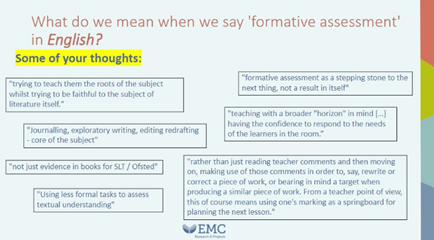
A recent TES article imagined one student who needed help with his reading and writing. The article suggested three diagnostic tests for this student: a fluency assessment in English, a diagnostic vocabulary assessment for Science and an ‘oral retell’ assessment in History. Each test was relatively simple and doable in lesson time (in many ways they weren’t tests at all, but examples of formative assessment). But in isolation, the tests are unlikely to have a significant impact on the student’s development compared to an ongoing, carefully guided focus on broad patterns of meaning and understanding in their language work. It’s not, of course, an either/or matter. The student needs to work on their literacy at both component and big picture levels. The issue is that the tests foreground the less important aspects of language development, so risking neglecting the more important ones.
There are diagnostic tests that foreground big picture aspects of literacy, while not neglecting component parts and, given that government announcements make the introduction of diagnostic tests feel like a fait accompli, we hope that schools are, at least, encouraged to adopt these if they must buy into (potentially very expensive) diagnostic packages. But ultimately, we think that making any tests of this kind mandatory is unnecessary and potentially damaging. Schools would be much better served by investing time and energy in developing their teachers’ ongoing use of effective, subject-specific formative assessment.
TES article: https://www.tes.com/magazine/teaching-learning/secondary/time-rethink-secondary-reading-assessment
Other EMC Curriculum Think Pieces
EMC Thinking About Curriculum - An Introduction
The Future of English Language at KS3 + KS4
Standard(ised) English - An EMC Think Piece
It's Time to Embrace Drama in English