The government’s response to the Curriculum and Assessment Review states that ‘a stronger focus on assessment’ is needed to improve standards in the KS3 curriculum. Aspects of the document offer hope for what this means, with a focus on curriculum breadth and adaptive, formative practice. For example:
Adaptive teaching and formative assessment are essential to helping pupils with different starting points make strong progress, including those with high prior attainment.
We couldn’t agree with this more, and it’s pleasing to see the intention to make sure that ‘training throughout a teacher’s career, has a strong focus on high-quality adaptive teaching, formative assessment and high expectations for all.’
But in other places, ideas about formative assessment blur into discussion of testing and collecting national data:
Identifying... gaps in understanding is critical and we expect all secondary schools to do so as part of their ongoing formative assessment from the beginning of Year 7 onwards. To support this, we will expect all schools to assess pupil progress in writing and maths in Year 8 and will support them to draw on a range of high-quality products to do so.
And
helping schools to strengthen their understanding of pupil progress in key stage 3 through assessments and by comparing their students’ progress to students in similar schools.
In an education landscape in which summative assessment already dominates, and the current structure of GCSEs in English dictate much of the curriculum content beneath them, it’s difficult to see how additional national testing, assessment ‘products’ and comparison of school performance can support schools in improving curriculum, formative assessment and adaptive teaching. In our 2022-24 research project into the state of assessment in KS3 English, we found that what English teachers need in order to improve their formative practice is to be freed up from existing burdensome summative assessment processes.
At present, many KS3 English curricula place too much emphasis on end of unit assessment pieces. Generally, we see KS3 English curricula arranged in half termly units, often with a formal piece of work at the end called ‘the summative assessment’. This piece is, most often, scaffolded analytical writing in some form. Somewhere earlier in the unit, often around the mid-point, there would be a preliminary, shorter piece of work called ‘the formative assessment’ designed to prepare students for the knowledge and skills required by ‘the summative assessment’ at the end of the unit.
The problem we found with this approach is that its focus is on the single pieces of work to be written (the most frequent mode) in the middle and at the end of each unit, leaving little room for giving attention to the curriculum, adaptive planning and formative practice in between these pieces of work. We found that curriculum breadth and challenge suffered as a result, with students reading and writing less because so much of their curriculum time each half term was spent preparing for ‘the summative assessment’. Time spent reading, in fact, was often minimised to make further space for this assessment piece, with some teachers explaining that they had to reduce whole texts down to extracts in order to have time to get the assessment completed, fed back on and redrafted each half term. Consequently, student books were sparse but for two pieces of writing per half term, with some limited recording of dates, titles, learning objectives, Do It Now tasks and other short activities in between. The two pieces of writing completed were in some cases highly scaffolded and therefore very similar across a whole class, with teachers unable to draw any meaningful conclusions about students’ strengths and weaknesses, and how these might be used to meet any fresh challenges, as a result.
During the project, we worked with two schools to see if we could change this dominant practice in a way that gave all students, regardless of their ability, a much broader, engaging and challenging curriculum, and focus teachers back on to creative pedagogies and formative assessment. So we asked them to trial taking the ‘summative assessment’ off the end of a unit of work for a half term. Once that piece of work was removed, teachers realised that getting to it had been the entire purpose of the unit of work – the assessment tail wagging the curriculum dog, rather than the other way around. Without the summative assessment, the unit lacked substance and there were few opportunities for students to generate creative and critical work in the variety of modes that they should be able to in English. This led the project teachers to rewrite units, discussing bigger picture aims and disciplinary variety, building in meaningful reading, writing and speaking and listening opportunities to challenge and support all students. Teachers were freed from the blinkers that ‘the assessment’, with its narrow focus, had created, and were able to see how little they had been meaningfully formatively assessing students within each unit.
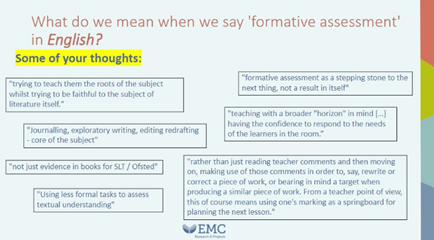
Developing a shared understanding of disciplinary formative assessment in our early project meetings was essential in laying the foundations for the curriculum, and practice, to improve. The teachers taking part had become quite used to an understanding of formative assessment as the piece of work they marked and returned to students ahead of their end of unit ‘summative assessment’. We reset this understanding, and discussed formative assessment in English as including:
- The wider unit aims and objectives within the curriculum as a whole
- Task and question design
- How to listen to student discussions and offer feedback and appropriate interventions
- Anticipating student knowledge and ability, using teacher prior knowledge of a class
- Looking at books, making judgements, marking as appropriate
- Making space for purposeful or corrective diversions and adaptations to tasks ahead
- Self and peer assessment
- How to judge quality in student work
- Working with colleagues to moderate and standardise work across classes.
The curriculum, we established, should be driven by teachers responding to varied student responses in these formative ways.
One crucial outcome in both project schools was the increase in the volume of good quality, disciplinary, creative work that all students, including those with Special Educational Needs, produced. As a result, teachers were able to gain a much more accurate sense of each student’s ability at any given time and use this to drive progress within each curriculum unit. This work required a significant increase in subject-specific CPD and training in disciplinary formative assessment practices for the project teachers. With time set aside, they were able to examine student work and critically rethink their approach, with excellent outcomes for students.
Our concern is that the CAR’s aim to increase the sequencing and specificity of the national curriculum is actually at risk of reinforcing the summative assessment-driven curriculum that has taken hold in the last twenty years. Alongside a promised increase in testing, schools’ anxiety about comparative national performance could worsen, and we could feel the impact in ever more tick box, narrowed curricula that lowers standards and reduces challenge for students, even as it aims for the opposite.
We have to hold out hope for the ‘strong focus on high-quality adaptive teaching, formative assessment and high expectations for all’. To achieve this, subject departments will need time to reflect on what this actually looks like in their subject curriculum and pedagogy, and time to make it happen. Unsurprisingly, we also think the focus needs to shift back to supporting teachers with subject-specific CPD, which whole school approaches to teaching and learning seem to have sidelined. If we have strong subject knowledge, and if we get our formative practice and curriculum right in each subject, we can be more resilient to the impact of any new number-crunching assessment ‘products’ that come our way in the future.