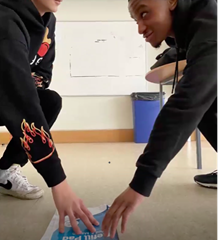
On my most recent visit to one of EMC’s Associate Teachers, I observed a Year 11 class engaging in what drama practitioners call ‘embodied learning’, where understanding is not confined to intellectual activity, but is also physically explored and internalised through movement, gesture and voice. Maddie Lynes from Waldegrave School, who is focusing on the use of drama in English lessons in her work with EMC, took what some would see as the unorthodox step of using drama to help her students revise for the AQA Worlds and Lives poetry cluster.
When you look at the evidence for the impact of drama activities on learning in English as outlined in a recent blog by my colleague Kate Oliver, Maddie’s approach doesn’t seem unorthodox at all. Theories of embodied cognition show us how learning can be shaped by physical experience, with abstract ideas becoming concrete when students use gesture, movement and role-play. In acting out roles and situations, they can enter directly into the worlds and characters of the texts they are studying and when they step out of role they can look back on what they have experienced and learned. As Kate wrote, ‘movement between immersion and reflection helps students notice layers of meaning, writers’ choices, audience and structure.’
The different stages of Maddie’s lesson are set out here, followed by a brief analysis, to give a flavour of what ‘embodied learning’ can look like and to offer a model for how such work might be carried over into different parts of the curriculum.
Stage 1 Establishing a theme
Students were asked to describe on mini whiteboards what ‘an ordinary life’ meant to them. In drawing out the answers, Maddie noted that some offered a positive interpretation and others a more negative one.
Stage 2 Charades
In groups, students played charades using the titles of the 15 poems in the AQA cluster. They were asked to reflect on this in their books, writing down what other students were doing physically to alert them to a poem’s title.
Stage 3 Reading the poems
Maddie read out the two poems that different groups were going to develop into a performance, ‘Thirteen’, by Caleb Femi and ‘On an afternoon train from Purley to Victoria, 1955’, by James Berry. While listening, students were asked to write down on their mini-whiteboards one or two ideas about how they might perform each poem and share this with a partner.
Stage 4 Developing a performance
Students were put into groups of 4 or 5, with half the class working on the Caleb Femi poem and half on the James Berry. They were instructed to develop a performance in which everyone took part, with each of the following to be included:
- a freeze frame
- a moment of unison (so everyone saying a word, phrase or line together)
- one phrase or line left unspoken but acted out (a ‘Strictly’ moment of silence for those who remember Rose Ayling-Ellis’s iconic couple’s choice).
Stage 5 Performing the poems
One group performed ‘Thirteen’, then another performed ‘On an afternoon train from Purley to Victoria, 1955’. Those watching were asked to note down the moments of freeze-frame, unison and silence.
Stage 6 Teacher-led feedback about the performances
Maddie led the class in feedback after each performance, with a focus on what they revealed about the idea of an ‘ordinary life’ in relation to the poems.
Stage 7 Reflective writing task
Students were asked to write as editor of an anthology of writing with the title ‘Ordinary People’, explaining why they had selected the two poems for inclusion.
Students were on task for the whole of the lesson. Maddie felt that the charades activity probably wasn’t needed and I would agree. Without it, there would have been time to watch one or two more performances, or to hear examples of the written work at the end. That said, it warmed students up for the more substantial task and planted the titles of all 15 cluster poems into their heads. It also established a link between the poems and physical movement.
The lesson really came alive when students were developing their performances (stage 4). You could sense the poems entering their minds and bodies as they grappled with what they meant and how this could be translated into action. The focus was relentlessly on meaning and interpretation rather than poetic technique.
The performances in front of the class were rough around the edges, but to me they were spectacular. Seeing ‘Thirteen’ acted out drew attention to its use of dialogue at various points and to the powerlessness of the 13-year-old protagonist in relation to the police, reinforced further when for the moment of unity the students in role as police all stood around the boy and said ‘You’ from ‘You fit/ the description of a man?’ while pointing at him.
The performance of ‘On an Afternoon Train from Purley to Victoria, 1955’ also drew attention to its extensive use of dialogue, this time between the Jamaican narrator and a Quaker woman. The students positioned themselves as if on a train and their choices gave a clear sense of how unthinking the woman was in her conversation and how elliptical the narrator’s responses. The line spoken in unison mirrored what the students chose to do in ‘Thirteen’. All the passengers stood around the narrator and demanded, ‘Where are you from?’. The students chose this moment as their freeze-frame, making the line emblematic of the whole poem.
I’m slightly wary of the truism that you need to hear poems read out loud to best understand them. Lots of poems are written to look a particular way on the page, with much of the meaning lying in their form rather than how they sound. This lesson made me reevaluate. It is indeed helpful to hear a poem read out loud, especially if it is performed by a group that has thought carefully about what they want to draw out for an audience. The performances helped me to think afresh about the two poems as well as embedding them thoroughly in my memory. Based on the responses the class gave to the performances, I would say that the same holds for the students.
After watching each performance, students were asked to talk to a partner about how the poem connected to ordinary life (stage 6), so linking back to the mini whiteboard starter activity. One student commented about ‘Thirteen’: ‘This shouldn’t be part of ordinary life at that age … when he laughs it shows shock and disbelief that this has happened. This doesn’t happen to ordinary lives – unless you’re young and Black.’ The teacher then probed further by picking up on the comment about race. ‘How can you link your comment to race and the fact that the speaker in the poem is Black?’ she said, with the student replying that ‘racial profiling can be common in parts of London.’ Watching from the back of the classroom, the assuredness of the students in their responses was striking. Their confidence came not from reading the poem but from seeing it enacted. They had witnessed the racism represented in the poem.
Responses to the James Berry poem were equally perceptive. When asked how the poem related to ordinary life, one student commented, ‘people can face probing questions because they are different.’ The ‘ordinary’ experience of being Black is again shown to be very different to that of white characters. As in ‘Thirteen’ attention is drawn to the central character because of the colour of his skin, a point of comparison emphasised by the performances.
It was interesting how quickly the students settled down to ten minutes of writing at the end of the lesson after they had been so active and necessarily noisy for much of the rest. Far from winding them up, devising, taking part in and watching the performances provided mental stimulation and generated ideas that made the writing task manageable and appealing. It was a moment of reflection that gave students the chance to articulate the new learning that emerged from the drama activities. Someone being critical might argue that the approach was relatively haphazard, not guaranteeing that everything in the poems was covered. I’d argue against this perspective on two fronts. First, everything was covered. The students were immersed in the two poems in their entirety: they experienced and enacted the whole poems. Second, it’s easy to cover the minutiae of the poems and different possible interpretations elsewhere – in revision guides and in the annotations students are likely to have made on the poems when they first met them. This revision work, to me, was much more important and sophisticated: generating new thinking, cementing old, drawing comparisons that may not otherwise have been thought of and making the poems memorable – the poem is no longer just a text on a page, but something felt, enacted, and inhabited.