One of my favourite teaching resources is Wilfred Owen's early draft of Dulce et Decorum Est. I love that, if it were a page from a student’s exercise book, it could be described as messy, scrappy even, but that is exactly what thinking in English often looks like; the draft is a conversation between Owen and the poem and student work should be ‘conversational’, involving exploration and dialogue.
This dialogic nature of writing – messy, tentative, revised and recursive – can often be overlooked in the pressure to prioritise technical accuracy over imaginative insight when it comes to assessment. The same is true for oracy: there is a risk that the emphasis on talk and dialogue in the recent curriculum and assessment review becomes translated as ‘learning to talk’ in very formal, prescribed and accurate modes such as debates and presentations. Yet the ‘messiness’ of classroom talk, talk-for-writing and writing-for-talk is essential if students are to have an authentic experience of the subject.
As an EMC Associate Teacher for 2024-2025 one of my aims was to adapt the EMC's research on teaching a novel at KS3 to my department's existing year 9 scheme of work on Jane Eyre, prioritising authentic student responses with opportunities for talk and dialogue. Using the EMC’s Full Text Study Edition and the ‘It’s Good to Talk’ project as a guide, we replaced lots of the existing lessons and tasks with ideas from other EMC projects and courses, such as journalling, 'open questions', statement banks and dialogic talk.
Teaching a nineteenth-century novel at KS3 is an admirable ambition, but comes fraught with risks and pitfalls: will the language be a barrier to comprehension? Will students need a considerable amount of front-loaded context? Will it just be boring? Despite its length, Jane Eyre has much to recommend it as a choice at KS3, including its single narrative voice and themes of growing up, criticism of adult authority and portrayal of the social pressures on young women. Yet, teachers do need to persuade students of the delayed gratification of persevering with a complex and subtle text such as Jane Eyre — what Harold Bloom once called literature’s ‘difficult pleasure’.
I also wanted students to produce an essay after reading the novel, but not under the high-stakes conditions in which GCSE essays are often planned and written. Instead, I was keen for students to experience a more ‘authentic’ mode of academic writing which would be closer to how literary critics actually take notes, draft, revise and edit their work before publishing. Many writers and critics have noted this ‘dialogic’ nature of writing, where writing becomes a conversation between oneself and the work.
I began by giving students an A3 grid of ‘big questions’ which they were explicitly told they would be writing about after reading the novel. These were broad and open-ended, such as ‘How does Jane change as a character?’ and ‘Which is the most significant motif in the novel?’ with spaces for students to add their own questions as we progressed. This was an adaptation of the ‘agenda’ – a resource used by the EMC in their work on novels which encourages students to reflect and elaborate on the connections between ideas as they read and avoids what can be the rigidity of the popular ‘knowledge organiser’.
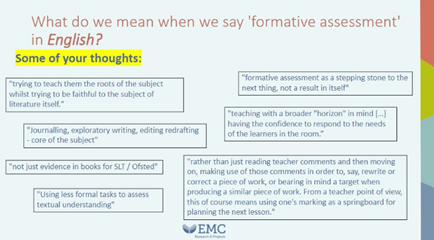
At the same time, during the reading of the novel, students were given lots of opportunities to talk and write about the ‘big questions’ in formative and informal, yet rigorous, ways. The stages this took were as follows:
- Students kept journals in the back of their exercise books. This is a space students often associate with ‘rough work’ so gave itself quite naturally to the tentative and provisional notes we wanted students to make in response to reading the novel. The journals then also formed a natural ‘record’ of their thoughts, feelings and ideas which they could refer to when looking back (‘I can’t believe I didn’t realise Rochester has a huge secret!’) in a genuinely formative way.
- Students were asked to journal about significant moments in the novel prior to discussion. This contrasts with the way in which writing is often seen as the ‘product’ and talk as the ‘process’ but is in fact closer to the way academic writing happens professionally. This ‘process writing’ allowed students to externalise their thoughts in a low-stakes manner – in fact they often ‘discovered’ what they thought during writing. However, this did need to be scaffolded to a degree, and the EMC study edition provides an excellent resource for getting process writing going. Giving students 'statement banks' with fictional students' ideas to which they could reply in their journals encouraged them to explore their authentic responses to the text in a loosely scaffolded manner. These statements need not be highly complex or based on GCSE assessment objectives. In Tell Me: Children, Reading and Talk, Aiden Chambers points out that critical insights can originate from simple observations. For instance, asking students to rank which characters they like or dislike after reading Chapter One is a deceptively simple task – but leads to students thinking about how Brontë often sets up characters as ‘allies’ or ‘enemies’ to Jane (Bessie-Mrs Reed, Helen Burns-Mr Brocklehurst). Of course, Mr Rochester will break this pattern. Below is an example of a statement bank from the EMC Full Text Study Edition which students used to journal about the ending of the novel.
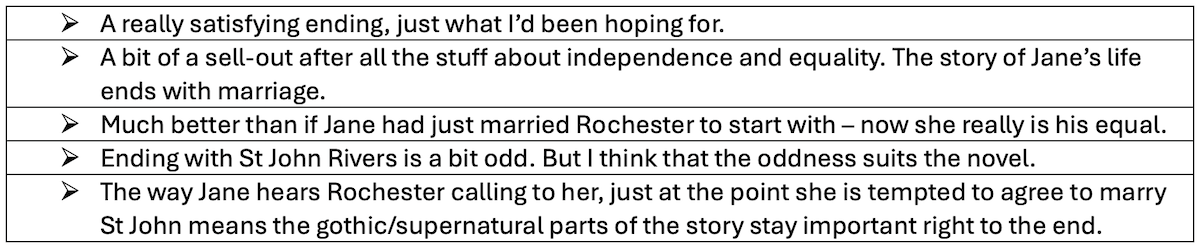
Students were simply asked to rank the statements in terms of which they found most interesting or insightful, before choosing one to which to write a short reply.
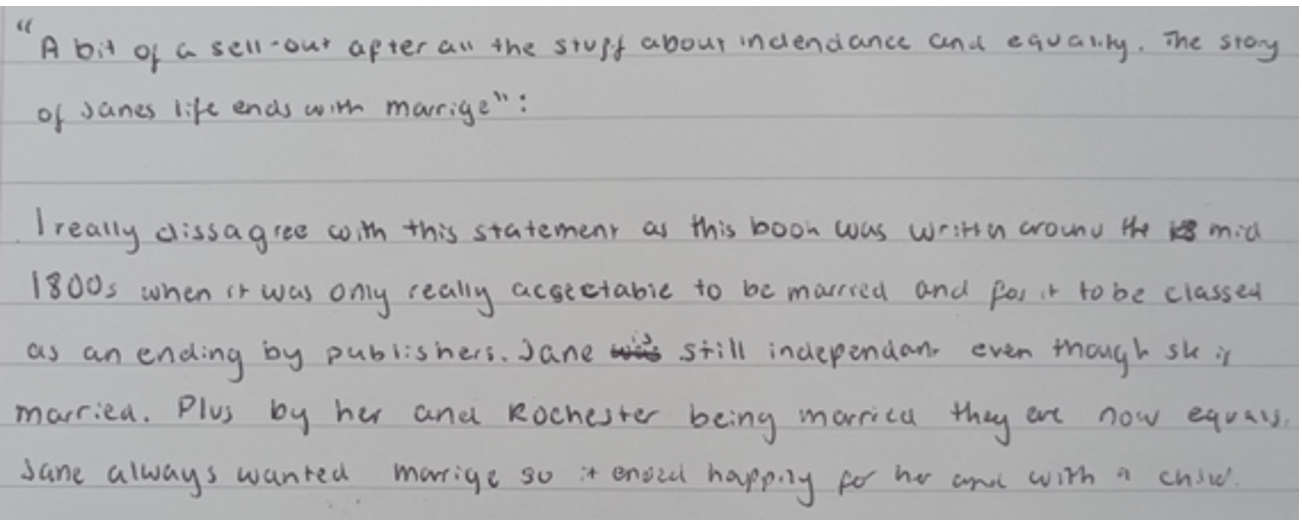
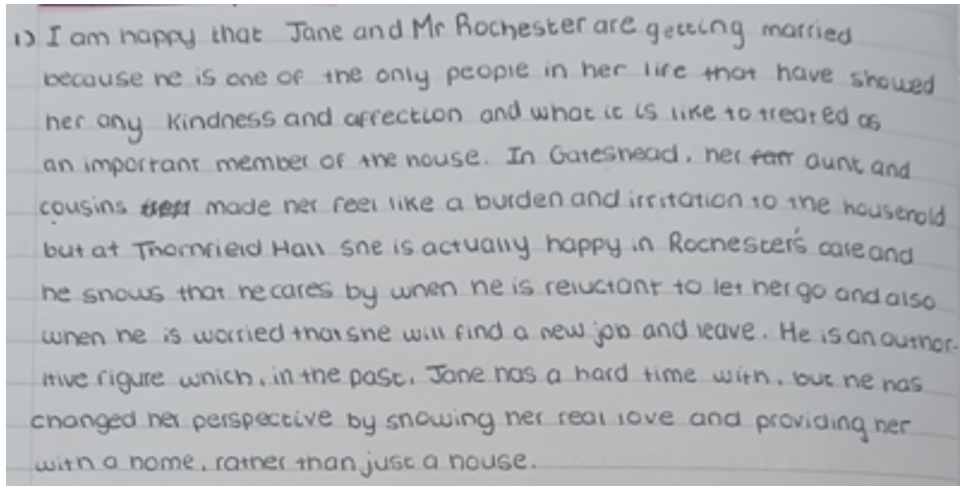
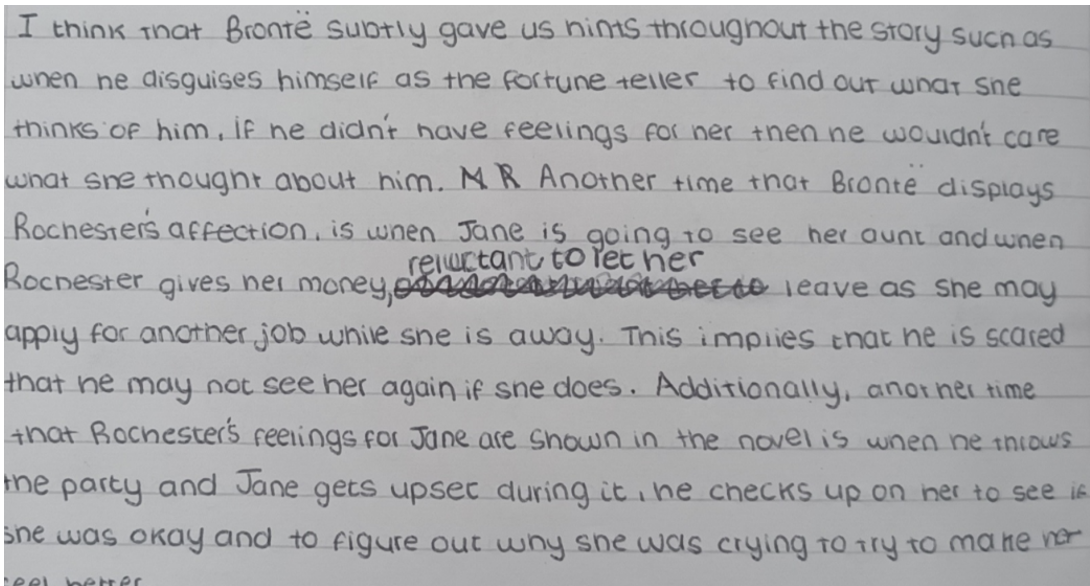
Whilst they may lack some of the features of GCSE essay (embedded quotations, detailed analysis), the insight into characterisation and its development over the course of the novel is very assured.
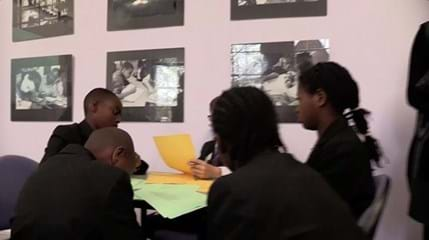
- After writing a short response in their journals, students were invited to share their ideas either in pairs, small groups or as part of a whole class discussion. Because students had been given the chance to organise their thinking, this discussion was frequently rewarding and challenging, often with clashes of ideas and opinions. Meanwhile, because the teacher could already see students’ thinking, it enabled them to invite all students into the discussion by recognising that their ideas were worth sharing. One important ambition during this phase was to aim for the ‘third turn’—a term used by oracy expert Robin Alexander in A Dialogic Teaching Companion—which describes when two students have responded to a question and a third student adds to the discussion without being prompted by the teacher. These ‘talk chains’ are often a feature of highly dialogic and rewarding classrooms but very difficult to achieve when students are asked to discuss their ideas cold or when the discussion is too scaffolded and students are expected to respond according to very strict templates.
- When students did, eventually, plan and write a short essay they were allowed to respond to one big question of their choice. This enabled students to use their journals as inspiration, with the essay draft being a ‘conversation’ between their reading, thinking, writing and talking. The results were surprising, not only in the depth of understanding and knowledge students displayed, but in the genuine sense of personal response and ‘big picture’ ideas which came across. Included below are three examples.
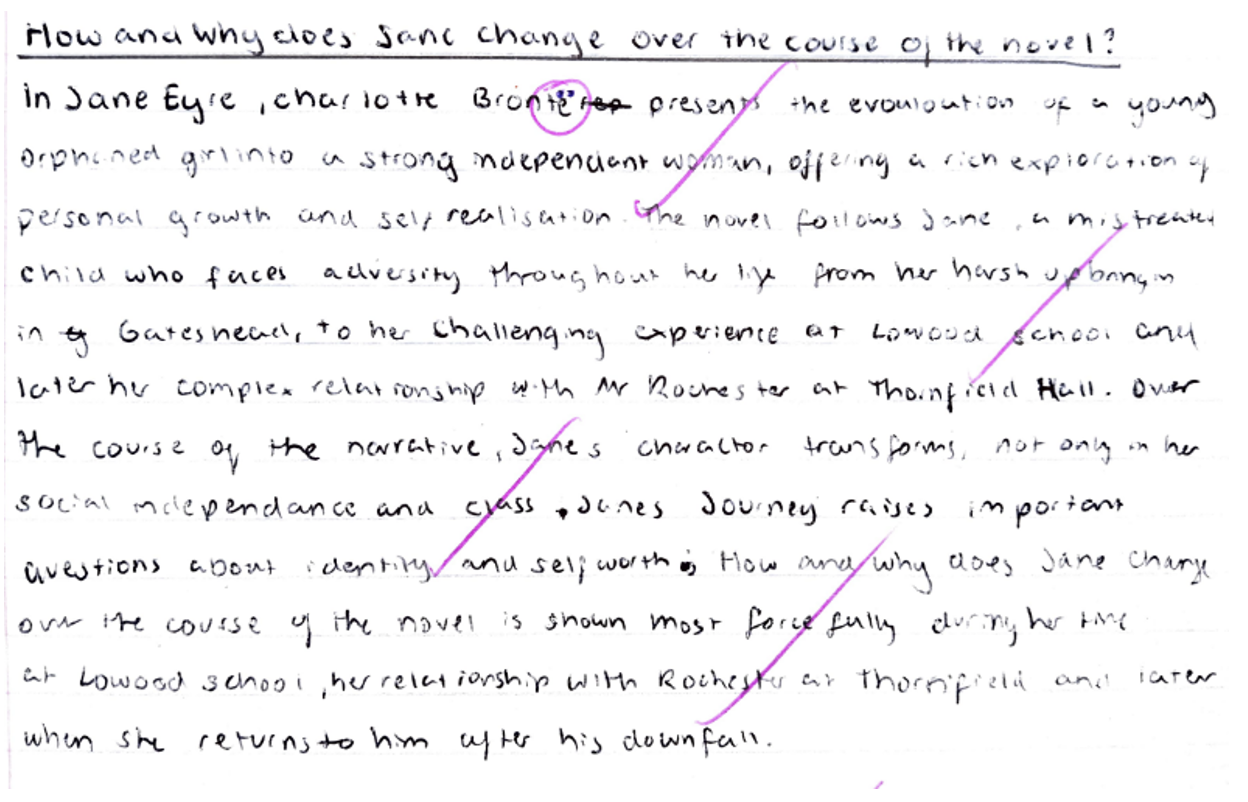
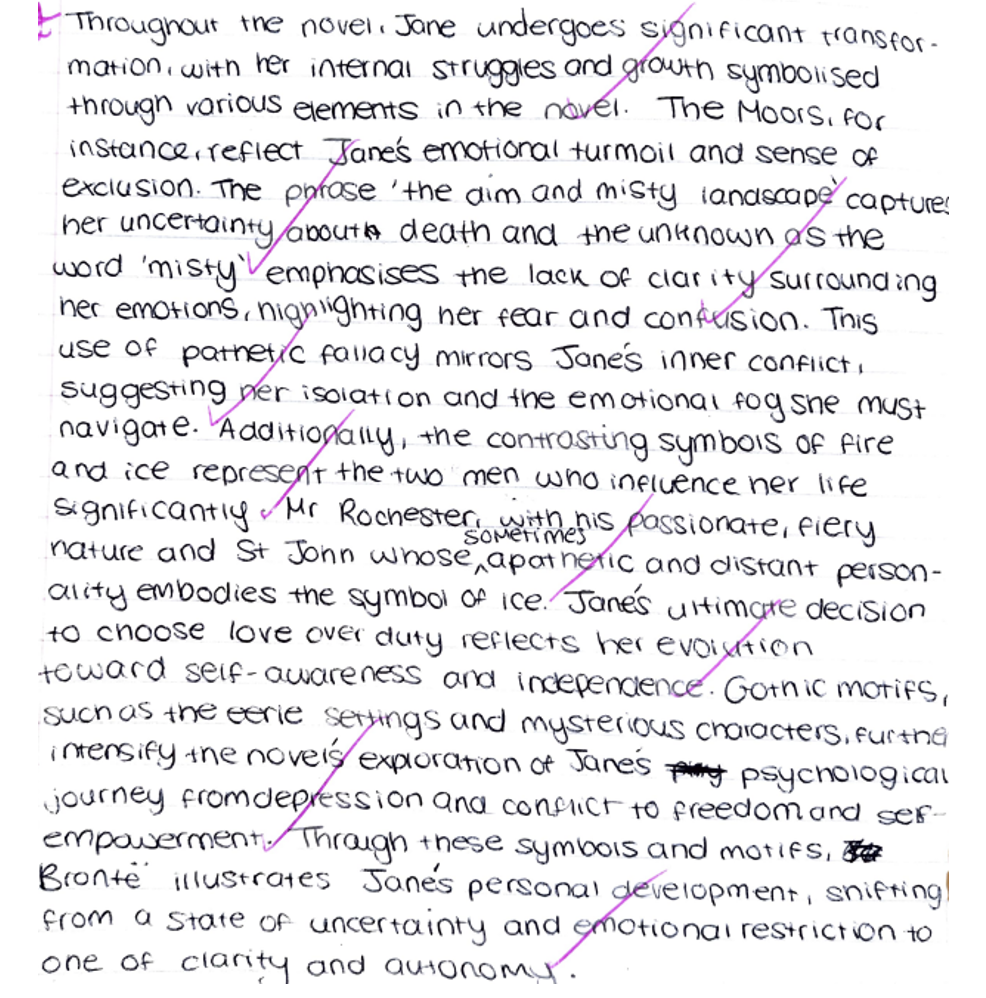
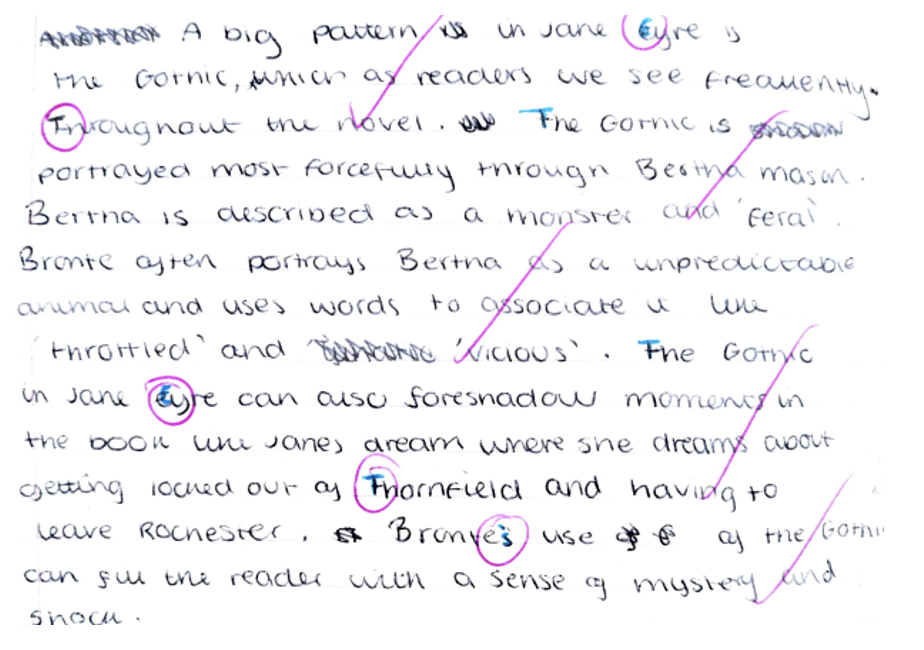
Many were thoughtful, original and a genuine pleasure to read in a way that essays at KS4 often aren't. More importantly, they gave students a glimpse of what Barbara Bleiman has called ‘Big Picture’ English—English as a conversation between readers, writers and critics which values students’ own experiences and wider knowledge. Like Owen’s draft of Dulce et Decorum Est, what underpins this approach is a view of the subject as dialogic all the way down. Whether in reading or writing, oracy is the ‘glue’ which holds the subject together and gives it its distinctive character: a conversation between students, teachers and the texts we study.
Works cited
Alexander, Robin. A Dialogic Teaching Companion. Routledge: 2020.
Bloom, Harold. How to Read and Why. Fourth Estate: 2001.
Chambers, Aiden. Tell Me: Children, Reading and Talk. Thimble Press: 1993/2011.
Andrew Stones is a secondary English teacher at West Kirby Grammar School and was an EMC Associate Teacher for 2024-2025.