Heading from London Euston to Sandwell and Dudley station, the words of English teacher, Sandy Millin were ringing in my ears, that if you mention Dudley to most people, 'they will generally repeat it back to you putting on the accent'. Few other places around the UK have that effect – Liverpool and Cardiff, perhaps – but it’s a testament to how well most people think they know the accent of that area (the Black Country in the West Midlands) and treat it as a bit of fun, or the butt of a harmless in-joke.
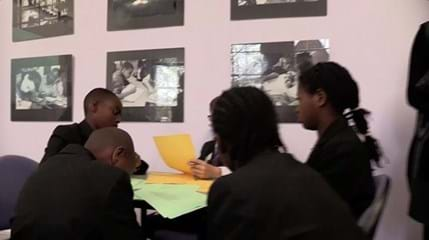
We considered some of Sandy Millin’s other reflections about the Black Country and its accents in a lesson with 23 Year 11 GCSE English students at Windsor High School and Sixth Form in Halesowen (about 5 miles from Dudley) in early December 2025: 'Hearing a Black Country accent reminds me of home, and now I enjoy listening to it much more than I did when I was in the process of losing it. I also like introducing students to the richness of accents we have in the UK. I hope it’s something we don’t lose any time soon because it tells a story of our history.'
Another Black Country resident, the poet Liz Berry, was the reason I was heading to this school to work with Aaishah Rauf (head of year 13 and one of the EMC’s Associate Teachers this year) and her students. Berry’s poem, ‘Homing’ is a great example of a literary text that draws richly on language heritage to make wider points about regional identity, class, belonging and a place you call ‘wum’ (‘home’). It’s in the AQA Worlds and Lives anthology, which is a relatively recent (and very welcome!) addition to the GCSE English Literature specification foregrounding poems about diverse identities.
While the current English Language GCSE could probably be sued under the Trade Descriptions Act of 1968 for misrepresenting what it covers (ie where’s the language study?) change is on the (slightly distant) horizon with the Curriculum and Assessment Review published a few weeks ago suggesting that more language study should find its way into Key Stages 3 and 4 from 2028. And Liz Berry’s poem is a great example of what you can do with some focused language study, some teachers with a background in linguistics and students who have first-hand knowledge of the dialect being discussed and all that goes with that.
Aaishah had already introduced the poem to the class in a previous lesson, playing a recording of Liz Berry reading her poem – something that really brings out the importance of the accent to the delivery and to the themes within it – so when I started looking at the background to the accent and dialect of the area, and some of the wider themes of accent discrimination related to accent study, the students could already see the relevance of the context being provided.
After a quick starter activity that asked students to define ‘elitism’, using it in a sentence and drawing a visual representation of what it meant to them, we launched into an introduction to the key ideas of accent and dialect using a few clips from an EMC online session that Dr Natalie Braber from Nottingham Trent University had recorded for a Year 10 and 11 taster session we put on in 2021 called Looking Into Language 2. It was also helpful that I was coming into the school with a different accent (perhaps London/Estuary English) so we could identify some obvious differences between our vowel sounds in words like path and bath, or bus and cup. We established early on that no sound is better or worse than another but it’s the social associations they bring to mind – the mental image created of the speaker of those sounds – that often lead to views about which accents are ‘nice’, ‘ugly’, ‘good’ or ‘bad’. As part of this introduction, we also looked at the ways in which linguists use dialect as an umbrella term that includes accent, but how dialect is often taken to mean words and grammar, rather than sounds.
We then had a quick look at an old BBC Voices explainer about Black Country dialect and some if its most familiar vocabulary. Just asking the students to read the title of the piece aloud (Yo’am alwright, aer kid) started discussions around the room about how unfamiliar it is to see your local accent rendered on the page and why this might be. It was a discussion that naturally led back to the starter on the word ‘elitism’ and how a certain dialect (standardised English) has come to have the most overt prestige out of all the dialects of the UK. There was an interesting discussion with one student about whether the word ‘tay’ ('tea’/’dinner’) was a dialect word or just a written down version of the Black Country pronunciation of ‘tea’. She was adamant it was a dialect term, and I was won round by her reasoning!
Next came the depressing part of the lesson: looking at attitudes to accents and the persistent accent hierarchy that exists in the UK. Using findings from the Accent Bias Britain project, we looked at 50 years’ worth of accent attitudes findings to see the ‘Birmingham’ accent (OK, not exactly the same as the Black Country accent but often included as such in these studies) languishing at the bottom of all three studies from 1969 to 2019. Some of the media stories about the local accents don’t pull their punches either: a 2008 study reported in The Guardian under the headline ‘Yorkshire named top twang as Brummie brogue comes bottom’ stated that the research 'found that people who said nothing at all were regarded as more intelligent than those with a Brummie accent', while a 2014 YouGov poll found Brummie the 'least attractive accent' in the UK.
The Accentism project collects people’s accounts of how their accents have been judged and we looked at three short extracts from the Black Country section of the website, featuring comments such as these below.
‘Ruth’: Growing up in Dudley in the 70s and 80s it was made clear to us at school that if we spoke with a Black Country accent that was wrong – punishments were given for using non-standard dialect such as 'bae' and 'dae' or saying ‘buz’ not ‘bus’. Furthermore, we were also told that if we spoke like our parents we wouldn’t get jobs – this was in the era when the steelworks were closed and the pits were closing.
‘Yampy Wench’: While I no longer speak with a strong accent it has marked me out as someone to laugh at or simply actively hate. Sitting miffed in interviews with people laughing so hard whenever I spoke they couldn’t catch breath. I’ve been asked if I know who my father is and received a long letter suggesting I never again aspire to anything due to my background, I’ve been refused service in shops, banks and cafes and graded downwards despite coming equal to or better than other peers.
Back in 2013, a school just down the road from Windsor High School, Colley Lane Primary (now part of the same multi-academy trust!) even made its own headlines when its headteacher sent a letter home, urging parents to ‘correct’ the ‘ten most damaging phrases used by children in their class’. Just looking at the list in the lesson cased a few raised eyebrows and it didn’t take much prompting from us to hear responses from students about how angry they were and how outraged their parents would have been to receive a letter like this, essentially telling them that their speech was defective! We discussed some of the terms focused upon in the letter and the wider debate about the place of dialects in schools and educational settings, but the view that seemed to get the most approval was one from a Daily Mirror article at the time, quoting parent Alana Willetts: 'The teachers should be teaching the children about the Black Country and our dialect. There are a lot of children who have no idea about local history. Some of my friends have gone on to be doctors and lawyers, I’m an engineer. It doesn’t affect you as a person. I think it is patronising and insulting to say that people with a Black Country accent are disadvantaged.'
As well as this picture of dialect prejudice, we touched on examples of local pride – t-shirts produced by local firm Punks & Chancers celebrating Brummie and Black Country voices, and the proud use of local accents by bands Big Special, Gans and singer Jorja Smith.
So it’s against this backdrop that writing a poem which both uses and celebrates local dialect, and reading it in a local accent, becomes quite a powerful act of resistance and celebration of local pride. Instead of just being a bit of tacked-on extra context, the discussions we kickstarted with the students around their dialect, their own use of it, their parents’ and grandparents’ use of it and their feelings about it, led directly into what Berry talks about in 'Homing'. We asked the students to write a short paragraph or two in response to two questions – ‘Why do you think it is important to Berry to use Black Country dialect in the poem?’ and ‘What examples can you see in the poem of where she is proud of her and her family’s local identity and how do you interpret them?’ – which were an attempt to link the broader discussion to the specifics of the poem.
You can see some examples of this work here.
The students were writing straight away and, in conversations with them around the room, both Aaishah and I were really impressed with the arguments being made and the examples being noted. The discussions often led back to their own understanding of their local dialect and showed how acutely tuned into it they were without necessarily always realising it. Aaishah noted that the discussions often revealed a deep-seated association among students of Black Country dialect with working class values, with some viewing other students who didn't know the dialect terms as ‘posh’. One student talked about how he noticed a school friend of his who had won a scholarship to a private school and whose accent had changed, while another talked about how she’d moved from Smethwick and was constantly aware of how different she had sounded to other students when she first moved. Another talked about how he had moved from Rowley Regis – an area just a few miles away – and how even over just such a short distance there were noticeable differences in accent. All of them could see how these discussions related to what Liz Berry was talking about in ‘Homing’ and how the use of dialect was as much about presenting a living and breathing identity as it was about capturing a memory of a grandparent and a time gone by.
Before leading into the final parts of the lesson, we widened the scope to take in an example of a different kind of accent being used but a poem about many of the same themes, Tony Harrison’s ‘Them & [uz]’, using a reading of it by the poet himself.
We thought that this was quite a good way to finish a one-off lesson but we also wanted to offer the students a chance to do a bit of research (or ‘me-search’ as I once heard Dr Amanda Cole talk about it in a presentation about her work on her family’s Essex accent), so the next stage of this was to ask students to get parents, grandparents and family friends to read the poem and talk about it, recording the conversations for use in a Lexis podcast episode we want to put together aimed at A level English Language students and their teachers. This way, we hope that we’ll be able to encourage some further discussion of the poem itself but also tap into the older generations’ use of the local dialect – or indeed, other dialects or languages – to map out a bigger picture of language and identity.
In many way, this work encapsulates for us what a linguistically-informed GCSE English lesson can be like and might be in the future: something that draws on genuine linguistic study, makes use of students’ own linguistic resources, relates directly to texts of all kinds (literary and non-literary) that they study in class and opens up critical discussions about language in society. It doesn’t artificially tack on context for the sake of context, but relates it directly to the language, themes and voices in the poem being studied and speaks across the often artificially separated disciplines of literature and language study. It also provides a snapshot of the kind of work students could go on to do more of in A Level English Language, something that few of them have an awareness of unless their teachers know the course!
We will see what happens with the students’ recordings and where they lead us in the next few months, but as a starting point we were happy with where we got to.