I have been an advocate for the EMC for a number of years, and have seen first-hand the impact their approaches have had on engagement and depth of discussion in the classroom. However, I had mainly implemented their approaches in our KS3 and KS4 curriculum and had only loosely integrated them into KS5. With the additional support available to me as an Associate Teacher, and this year’s timetable meaning that I had a Year 12 class all to myself, rather than our usual shared class approach, it seemed a good time to experiment with how creative-critical practices, an important element of EMC's approach to pedagogy, could enhance A Level teaching and the quality of the responses produced by our students. Working at a girls grammar school, I knew there might be some scepticism as our students are very exam focused, and my experience of embedding similar strategies in KS4 had shown that exam groups could be unsure about whether these tasks would adequately prepare them for their final assessment; frequently, when given the choice between a creative-critical task and a more ‘traditional’ critical response, Year 10 and 11 students select the traditional task as it is more closely aligned to their final exams. However, I could also see that I had a class with the potential to be creative and exploratory, and students who would be willing ‘guinea pigs’, so I decided it was worth a try; the aim of this year was to focus on ways creative-critical approaches can go beyond increasing engagement and can enrich interpretation and develop writing in more conventional critical forms, so I wanted to take the opportunity to build up a bank of evidence of the impact of these creative-critical approaches on critical writing with my Year 12 class. We used imaginative methods of recording students’ initial ideas such as journals and collages and then followed these up with a range of creative-critical and critical-creative tasks, once we had built on these initial responses through discussion and exploration of the texts, which allowed students to demonstrate their understanding which had developed.
Creative-critical Approaches and the Study of Set Texts
Poems of the Decade – Poems in the Style of 'The Gun'
I began by implementing a few creative strategies during our teaching of the Poems of the Decade anthology; for instance, after reading Vicki Feaver’s ‘The Gun’ I tasked students with writing their own poem following several of the same aspects of form and structure to develop a deeper understanding of her use of enjambment, shifts in tone and the impactful final image. I quickly saw how many of the students thrived when given a creative way to explore the poems, and received some exceptional poems which, implicitly, showed a secure understanding of the form and structure of Feaver’s. For instance:
THE TRUTH
Bringing truth into a house
changes it.
You lay it out on the kitchen table,
tentative, as though it is something living
itself: the web of details and soft-spoken
confessions stretching out before Eternity,
sweetness turning to sour wine
spilt on your mother's perfect lace.
At first it's just silence:
forgotten invitations
left teetering on a banisters,
passive as a tiger against the pine.
Then a single stroke of the cheek:
clear cut contempt.
Soon the flesh spoils with blossoms
of violet and evergreen.
Your hands shine with devotion
and tears. You squash
my care and fears. There’s a violence
in your smile; your eyes hazy
like when pleasure meant drink.
Truth drives a house to madness.
I join in the folly: laughing and listless,
smiling and screaming –
bewitched as if the Twice Born Lord
had neared for war, striding
from ivy covered groves,
his flaming jaws
spilling crimson vipers.
This poem in particular reveals this student’s understanding of the way Feaver’s original tracks the speaker’s changing relationship with the gun through their ability to implement tonal shifts, tracking the speaker’s relationship with the concept of truth through aspects of form and structure such as single sentence stanzas and line breaks for emotional impact. I was also impressed by the way they had identified Feaver’s characterisation of the gun as a living, breathing entity, almost a third member of the household, and mimicked this in their personification of truth. Their work also demonstrates their understanding of the stylistic shift in the final lines of the poem, implementing a powerful final image which includes mythical imagery to capture the lasting impact on the speaker and create an unsettling conclusion for the reader. Their attention to detail, down to the use of colour imagery in the final line and the use of listing to show the speaker’s growing engagement, shows how much the student has been able to unpick about Feaver’s technique without explicit instruction. When I use this activity again next year, I will experiment with asking students to produce a short commentary to accompany their poem, so they can articulate what they have learnt about Feaver’s poem and make explicit their process so they can be more deliberate in their analysis in any future essays; it is clear this student has identified a range of elements in Feaver’s poem, but I would like to ensure that they are clear on what they learnt about the effect of these when producing their own writing.
Widening the Creative-critical Project
Having seen the creative potential of our cohort, and having seen that these creative-critical responses offered scope for students to demonstrate in-depth understanding of writer’s craft, I began to integrate these types of task more frequently into our curriculum. I spoke to a colleague, who was teaching our second Year 12 class, and we made the decision to turn this into a wider-scale project, deliberately incorporating a range of new strategies throughout the curriculum in Year 12 and using it regularly to complement our more conventional pedagogical approaches. I have also been pleased to see that students have not been reluctant or anxious about these approaches, as I initially feared, as one student said ‘I find them helpful as it encourages me to learn the content through other perspectives – which I can refer back to in essays’, showing that they have been able to see the links between more creative and imaginative strategies and their final assessments in a more conventional essay form.
This year, we have seen a marked increase in enthusiasm and engagement in our students in comparison to previous cohorts; the energy in the classroom is infectious when they are given the opportunity to engage in more creative responses and the discussions between students are lively and passionate, allowing students to engage in critical debate and explore texts and characters from a range of perspectives. While ‘enthusiasm’ and ‘engagement’ can be hard to quantify, students have willingly given up significant amounts of time outside of lessons, without instruction from us, to develop their creative responses, including filming, editing and recording short films and podcasts. With a national decline in A Level English students, I hope that embedding these approaches may allow us to retain our healthy A Level cohort and perhaps even see an increase in uptake. According to one of our students, ‘I have loved these creative tasks as they have really helped bring our learning to life’ which I think encapsulates the tangible change I have seen within the classroom.
In addition to the increased engagement in the subject, it is undeniable that these approaches have also allowed students to demonstrate an in-depth, critical understanding of their texts and consider multiple perspectives; without the constraints of an ‘essay’ or formal question for them to answer, students have been given the freedom to consider the texts more organically, which has yielded lots of thoughtful ideas.
A Streetcar Named Desire – Beyond the Essay
One such example was a project we gave to our students at the end of our unit on A Streetcar Named Desire. What would previously have been a debate about whether fate or desire is the greater cause of tragedy in the play, leading to a formal written response, became a critical-creative task where the focus was on getting students to reveal high-level thinking about the play through critical writing, but in a less conventional, more creative form; students were given the choice to respond to this debate through a script for a podcast, an emagazine-style article (we use our emagazine subscriptions regularly in lessons and for homework), a transcript for a social media-style revision post etc. We had originally intended for this to be a one-lesson task, wrapping up a sequence of lessons on tragedy, but instead we extended this into a three-lesson sequence, at the end of which our students had scripted, filmed and recorded podcasts, mockumentaries and YouTube revision videos, some of which were more than 15 minutes long (and largely completed outside of lesson time). While these were entertaining in their own right, with students thriving under the opportunity to create silly characters (although drawing on images and cultural aspects of the play) and use humour, they also yielded thoughtful and evaluative conversations about the themes of fate and desire, and engaged in debates about their interrelationship. Forms such as a podcast are a naturally discursive and enable students to adopt differing perspectives and engage in a critical conversation about the text, unlike a conventional essay; this means that students are more likely to consider the text from multiple angles and offer alternative interpretations, understanding complexities within the play rather than simply offering one central reading and argument. In my experience, they often reach more interesting insights about the text as they have a freedom to challenge one another and writing in a more informal manner allows them the room to express ideas which they may not have felt confident expressing in a more academic style.
An excerpt from one group’s script
NARRATOR (‘FLORES!’)
Hold up, hold up. How did we get here? Let’s go back to where this began.
[time rewinds as a scratching record sounds.]
SALLY
No, no, no; think about it. It’s fate. Every single tragedy boils down to fate. Macbeth: The witches. Oedipus: The prophecy. Streetcar-
JUAN
Uhhh are you sure that one’s fate?
[JUAN looks to MANUEL, searching for some form of agreement.]
SALLY
Well sure. It's in the name- Streetcar. We know how much Williams loves to use his symbolism. The streetcar appears in conversation multiple times throughout the play. It symbolises the uncontrollable and relentless driving force that is fate which inevitably leads Blanche to her downfall. I mean, the ‘rattle-trap’ streetcar operates on fixed rails. It’s just begging for us to take notice of the fact that this psychological journey of Blanche’s was predetermined and unstoppable. Before the play even begins the streetcar ‘brought’ her here ‘Up one old narrow street and down another’. Williams is revealing her lack of agency in how she got to the events of the play
MANUEL
Well you’re right about one thing, it is in the name! It’s a Streetcar Named ‘Desire’! Desire brings her to New Orleans – if the play were about fate, wouldn't Williams have called it ‘A Streetcar Named Fate’? Plus, Blanche herself says ‘they told me to take a streetcar named Desire, and then transfer to one called Cemeteries {...} and get off at – Elysian Fields!’ She maps her journey through the play! Desire drives her to her inevitable death (‘Cemeteries’ – ‘Elysian Fields’). Not fate.
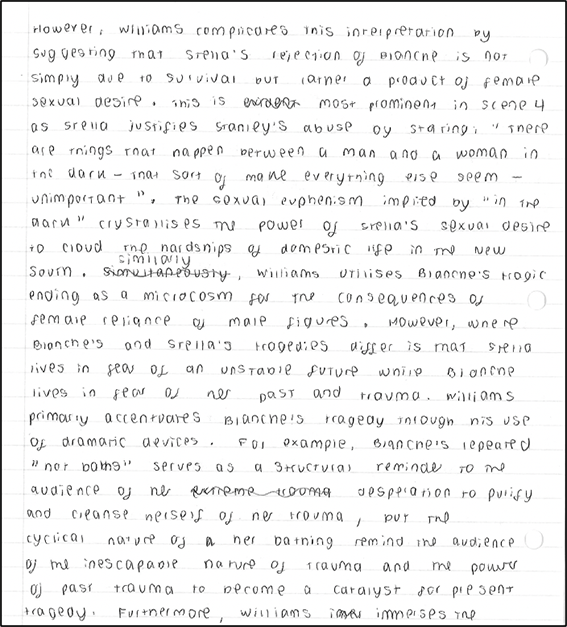
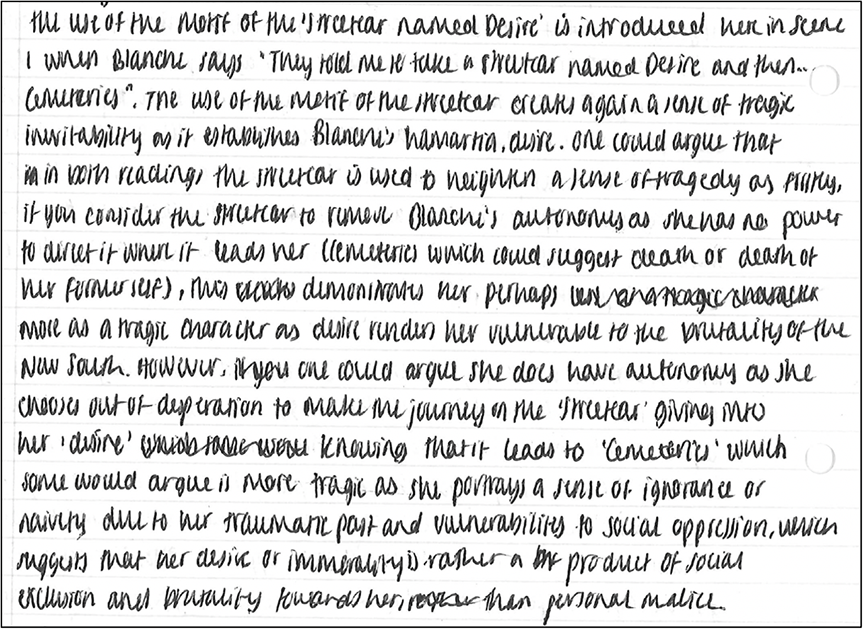
When students later wrote an essay on tragedy in Streetcar, it was pleasing to see that they were still able to discuss this theme with confidence in a more traditional form, and were able to draw on the ideas they had discussed relating to desire and fate:
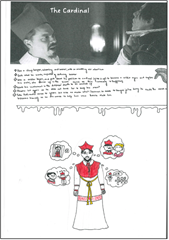
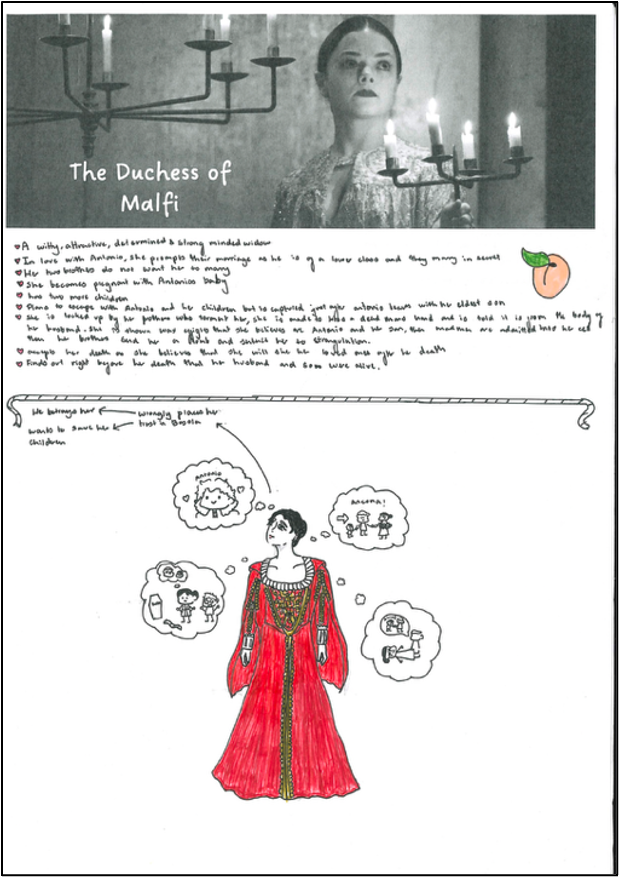
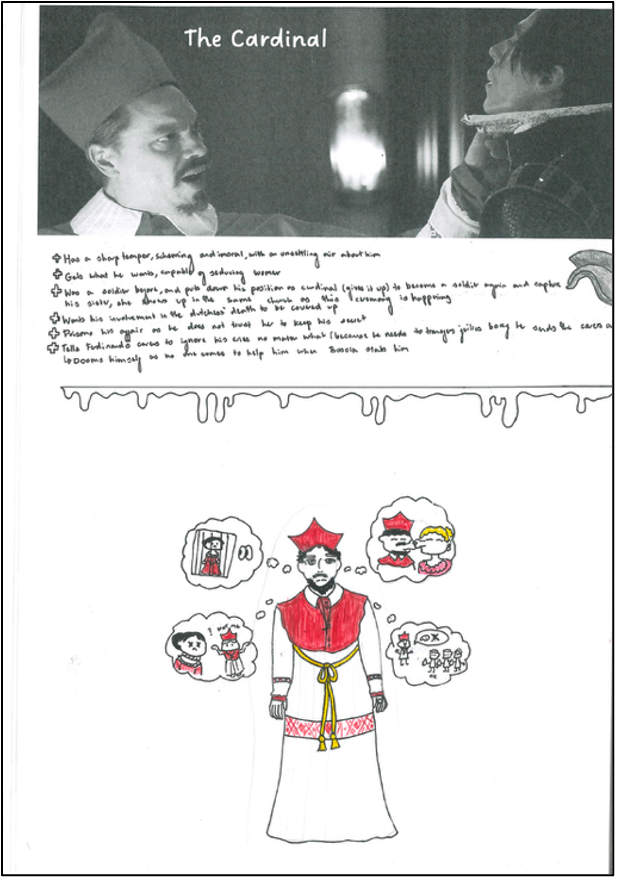
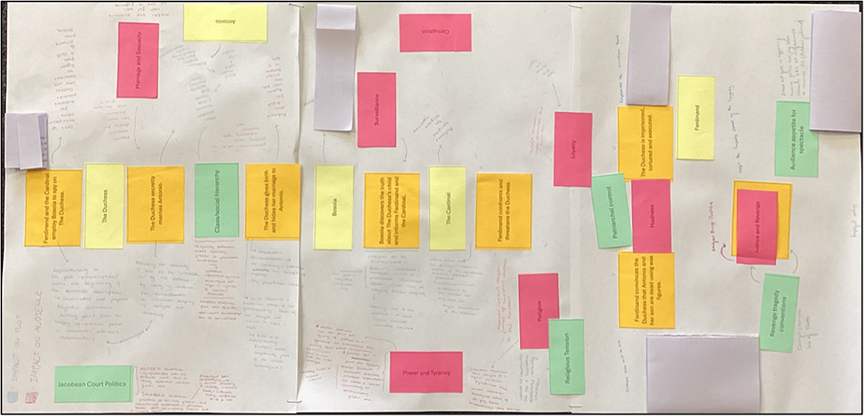
We continued our project into our coursework study, continuing to use less conventional approaches to support students’ more independent study. We taught The Duchess of Malfi as a core text this year, with students selecting their own second text and question; we used a journal for students to track their understanding of characters and themes, completed a collage task to enable students to explore links between context/themes/characters/quotations (examples below). Using these more imaginative methods for recording students’ interpretations of the play created greater freedom in allowing students to share their initial responses to the text – it is important to capture students’ first impressions, but a more conventional critical paragraph can sometimes feel daunting for students if they are not sure how to articulate their thoughts or are still working through their interpretations. For instance, the journal entries revealed students’ awareness of the characters’ conflicts and the differences between their public and private personas, even if they were not able to identify them as such at this early stage, through their thought bubbles and bullet points referencing the Duchess as a ‘witty, alternative, determined and strong-minded ruler’ and the Cardinal as ‘scheming and immoral, with an unsettling air about him’. These approaches gave students the space to express their thoughts and feelings about characters, which we could then develop through classroom discussion and more creative-critical/critical-creative approaches such as writing in role (we saw some highly entertaining social media ‘lives’ in role as Ferdinand!) and writing their own emagazine article (example below).
The Duchess of Malfi Approaches
Next Steps – Embedding Creative-critical Approaches
After our pilot this year, I can say with complete confidence that creative-critical approaches have a place in our Key Stage 5 curriculum. The increased engagement and passion for our subject is something which has made teaching Key Stage 5 this year so much more dynamic, but it has also proven a powerful tool in supporting all students in accessing challenging texts and developing their analysis. The students themselves have also attested that they have found these approaches useful, identifying an additional benefit that they aid their memory of content, something I had not previously considered: in their words, ‘certain tasks such as writing our own poems make it easy to memorise aspects of it, such as the structure or techniques the poet uses’ and they find these approaches helpful in ‘ensuring that all the poems and texts don’t blend into one’.
It has also been a really effective way to introduce alternative interpretations and critical readings; using podcasts, social media posts ‘in role’ and visual approaches to consider a character through a particular lens has made these more challenging concepts far more accessible. Moving straight to literary theory can lead to difficulties in students understanding abstract concepts, or showing reluctance to ‘disagree’ with established critics, but by providing students with the chance to engage in dialogue about the texts, perhaps behind the mask of particular roles/perspectives, they can begin to consider alternative interpretations, and how they can move beyond simply agreeing or disagreeing with an opinion; these creative-critical tasks have shown them how to interrogate, challenge and synthesise different viewpoints to come to their own judgement. We are already planning how we can use these approaches to elevate our teaching of the Shakespeare component next year to support student analysis and the application of alternative interpretations and critical readings, as well as hopefully allowing our students to perhaps even enjoy the dreaded nineteenth-century novel!